What workshop documentation contains and why you need it before fabrication
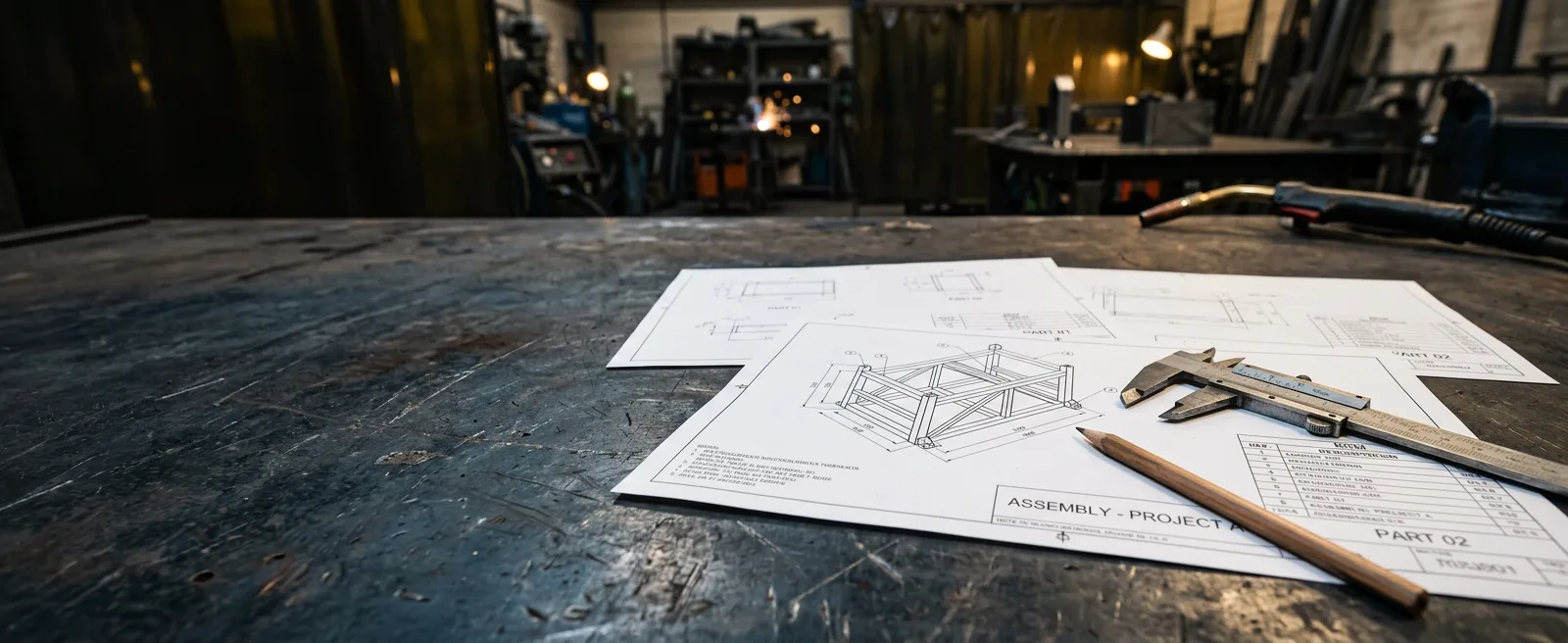
When a project goes into fabrication without clear documentation, problems almost always show up in the workshop or during erection. Time is lost, more material is used, and questions arise that should have been resolved much earlier.
Workshop documentation is not paperwork — it is a tool that helps get the job done accurately, faster and with fewer mistakes.
For metal fabricators, contractors and investors, good preparation means less improvisation. And less improvisation generally means fewer delays, fewer complaints and better control over the whole project.
What workshop documentation is
Workshop documentation is a set of technical drawings and data used to fabricate, assemble and install an element. It is not just a "drawing for review" — it is the concrete basis for cutting, drilling, welding, assembly and installation on site or in the building.
In practice, workshop documentation translates an idea, a main design or a 3D model into something the workshop can use right away. When the documentation is well prepared, every party knows their part of the job:
Knows what has been defined and can check whether the execution matches the intended design.
Knows exactly what to fabricate — no guessing, no phone calls, no waiting for extra explanations.
Gains greater confidence that the finished product will match the agreed design.
It is especially important for metalwork and steel structures, because mistakes there can rarely be "hidden". If a hole is misplaced, the connection does not fit. If a dimension is not clearly defined, the part has to be reworked. If the assembly sequence is unclear, the problem moves to erection, where every mistake costs more than in preparation.
What workshop drawings usually contain
Workshop drawings must provide enough information so that fabrication does not depend on assumptions. The drawing has to be clear, readable and made for the person who actually works from it — not just look tidy on a screen.
As a rule, workshop documentation contains:
- basic dimensions of the elements
- positions of holes, slots, notches and openings
- designations of profiles, sheets and other materials
- connection details
- weld symbols where required
- number of pieces and position marks
- information relevant for assembly and erection
- DXF files for laser or plasma cutting, if needed
If the workshop has to call and ask what the author meant, the documentation is not good enough. A good drawing does not have to be "pretty" in a marketing sense, but it must be unambiguous.
The level of detail matters too. Sometimes it is enough to show a simple element with dimensions and holes, but more complex assemblies also require sections, connection details, position marks and the assembly logic. In other words, the documentation must match the real complexity of the project.
The difference between part, assembly and erection drawings
These terms often get mixed up, and the difference matters because each drawing has a different function.
| Drawing type | What it shows | What it is for |
|---|---|---|
| Part drawings | One specific part — a sheet, beam, plate, profile or stiffener, with all dimensions, holes and material designation. | Fabricating the part as a standalone position: cutting, drilling, machining. |
| Assembly | How several individual parts form a whole — what goes where, where the connections are, the main dimensions of the assembly. | Assembly and welding; defines the assembly logic. |
| Installation | How the finished elements are placed on the building — positions, reference levels, axes and connections to other elements. | Installation on site; sets the sequence that makes erection easier. |
The part drawing shows one specific part. If the workshop cuts or drills a part as a standalone position, the part drawing is the fundamental document.
The assembly drawing does not just show what the assembly looks like — it explains the relationship between the elements. For welded elements the assembly drawing is especially important because it defines the assembly logic.
The erection drawing goes one step further — it tells you how the finished elements are placed on the building. For larger metalwork and steel structures, it is often the erection drawing that saves the job on site.
When someone says they "need a drawing", that is too broad. In serious preparation you need to know whether you need a part drawing for fabrication, an assembly drawing for putting parts together, or an erection drawing for installation. Most often all three are needed, because each solves a different problem.
Why you need workshop documentation before fabrication
The shortest answer: because the cost of a mistake grows with every step it goes unnoticed.
1. Checking the design logic
When workshop documentation exists before fabrication starts, it is easier to check the logic of the whole design. Clashes between elements, illogical dimensions, problematic connections, insufficient clearances and impractical welding or erection details can be spotted. This is especially true when the documentation is produced from a 3D model, because it is much easier to see how the parts really sit relative to each other.
2. Production control
When workshop drawings are clearly prepared, there are fewer verbal explanations, less reliance on "the craftsman knows how it goes" and less improvisation. This matters for small workshops and larger projects alike. A good drawing does not replace the fabricator's experience, but it gives them a reliable basis to do the job without unnecessary backtracking.
3. Communication
The investor wants to know what they are getting. The contractor wants to know exactly what needs to be done. The workshop wants to know how to fabricate the parts. The erection team wants to know how everything fits on site. Workshop documentation is the common language between everyone involved.
Without it, the project is often run through messages, phone calls, paper sketches and after-the-fact explanations. That may work for a small job, but for more serious metalwork and steel structures such an approach very quickly becomes expensive.
What good preparation before fabrication looks like
Good preparation starts with defining the input data: measurements, existing conditions, the investor's requirements, possible space constraints and the installation method. If the initial information is poor, even the best workshop drawings cannot fully fix the problem later.
After that, you need to decide what is really required for execution. Sometimes a part drawing and a DXF file are enough. Sometimes an assembly drawing, an erection drawing and additional connection details are essential. The documentation should be neither too sparse nor overloaded — too little detail creates mistakes, while too much irrelevant information slows down reading and increases the chance of confusion.
For sheet metal and cutting, DXF files for laser or plasma speed up the job further because they reduce manual redrawing and transcription of dimensions. For more complex structures, a 3D model helps verify the geometry and assembly logic before fabrication. Indicative prices for models and documentation are available in our price list.
The best result comes when the documentation is not made as a formality, but as a tool for real production. Then the drawing serves the workshop — not the other way around.
Conclusion
If you want fabrication to run more smoothly, more precisely and with fewer expensive corrections, the workshop documentation should be settled before the material even goes into processing. The part drawing defines the part, the assembly drawing connects the elements, and the erection drawing makes installation on site easier.
When these steps are clearly prepared, both the workshop and the investor have far more control over the result.
Request a quote for documentation